How Long Does It Take to Build a Website?
Most small business websites take between one and six weeks. The build itself is rarely the slow part. Here is what actually sets the pace.
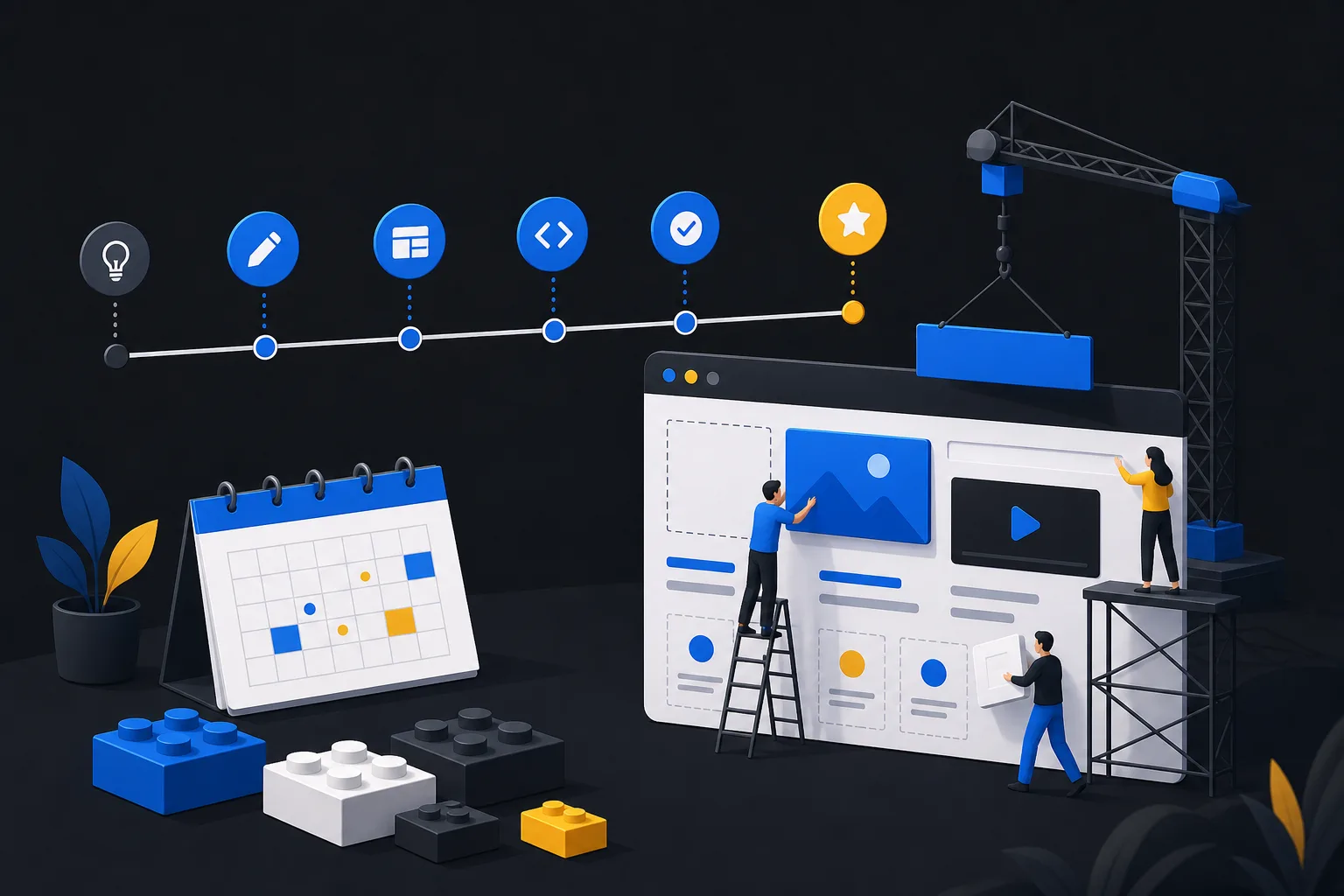
"How long will it take?" is usually the second question an owner asks, right after the price. It is also the question with the least reliable answers in the industry, because the honest answer depends far more on you than on the designer.
Here is a realistic breakdown of where the time actually goes.
The headline numbers
For a UK small business, typical end-to-end timescales look roughly like this:
- A small brochure site of four to six pages: one to two weeks.
- A ten to fifteen page site with service and location pages: two to four weeks.
- A site with booking, payments or customer accounts: four to eight weeks.
- E-commerce or genuinely custom functionality: six weeks upwards.
We launch most standard builds within a week. That is achievable because our process is fixed and our packages are defined, and it holds true when the content is ready. When the content is not ready, no process in the world speeds it up.
Where the time actually goes
Discovery: one to three days
A proper conversation about what your business does, who your customers are, which services make you the most money, and what the site needs to achieve. Then a page plan you approve before anything is designed.
Skipping this stage feels faster and almost always costs more time later, because you end up redesigning pages that were built on a guess.
Design: two days to two weeks
For a package build working from an established design system, this is quick. For a fully bespoke design with several concepts and rounds of feedback, it is the longest phase of the project.
The variable here is not the designer's speed, it is how many rounds of changes happen and how quickly feedback comes back. Our packages include two rounds of revisions as standard, with three on Pro Growth, which is deliberate: unlimited revisions sound generous and in practice they stretch projects out for months.
Build: two days to two weeks
Turning approved designs into working pages. Speed here depends mainly on page count and functionality. Static pages are quick. Anything with a form that does something clever, a booking calendar, a payment step or a login is slower because it needs building and then testing properly.
Content: the real variable
This is the phase that decides your launch date, and it is almost entirely on your side of the fence.
You need, at minimum: a description of each service, an About page, contact details, opening hours, and photographs. If you have these ready, a build can move at full speed. If your service descriptions are still in your head and your photos are on a phone somewhere, the project waits.
The honest pattern across the industry is that content is the most common cause of delay on small business websites, by a wide margin. Not design, not development. Content.
Testing and launch: one to three days
Checking every page at phone, tablet and desktop sizes. Testing every form and confirming the emails arrive. Checking speed. Setting up analytics and Search Console. Configuring the domain and SSL certificate. Then going live and checking everything again on the live server, because things do behave differently there.
Domain changes can take up to 48 hours to propagate fully, though it is usually much faster. Worth knowing if you are timing a launch around an advert or an event.
What makes a project run late
In rough order of how often each one bites:
1. Content arriving slowly. Covered above. It is the big one.
2. Slow feedback. A design waiting five days for a reply adds five days to the project. Small businesses are busy, which is entirely understandable, but it is worth booking half an hour in the diary for each review point.
3. Too many decision makers. Two business partners with different tastes and no agreed tiebreaker can add weeks. Nominate one person to give final sign-off.
4. Scope creep. "While we are at it, could we also add online booking?" Every addition is legitimate and every addition moves the date. Note them, price them, and decide whether they go in now or in phase two.
5. Third parties. Getting access to an old hosting account, transferring a domain from a former developer, waiting on a photographer or a copywriter. Start these on day one, not week three.
6. Missing logins. Domain registrar, hosting, existing website admin, Google Business Profile. Hunt these down before the project starts. If a previous developer holds them and has gone quiet, recovery can take weeks.
How to make it fast
If speed matters to you, here is the practical list.
Before you commission anything:
- Write a paragraph about each service you want on the site.
- Gather 20 to 30 photographs of your own work.
- Collect your reviews and testimonials in one document.
- Find your domain and hosting logins.
- Decide who has final say on decisions.
During the build:
- Reply to feedback requests within a day or two.
- Give all your comments in one go rather than in a trickle.
- Be specific. "The heading should say X" is actionable, "it doesn't feel right" is not.
- Keep new ideas on a list for phase two.
Do those and a one week launch is genuinely realistic. Our web design packages are structured around exactly this, with a clear scope and a defined number of revision rounds so the project has a natural finish line.
Should you rush it?
Sometimes yes. If you are starting a business next month, or your current site is actively embarrassing, or you have a seasonal window closing, getting something solid live quickly beats perfecting something that launches in November.
A smaller first site that you extend later is a perfectly respectable strategy. Our Starter package at £499 + VAT covers four pages, which is enough for many local businesses to start winning work, and you can add pages later as the business grows. All the tiers are laid out on our pricing page.
Sometimes no. If the site is your main sales channel, or you are investing significantly in advertising to send traffic to it, take the extra fortnight and get the content right. A rushed site with weak copy and poor photos will underperform for years.
What our timeline looks like in practice
For a standard package build:
- Day 1: discovery call and page plan agreed.
- Days 1 to 2: you send content and images; we start design.
- Days 3 to 4: you review the design and give feedback in one round.
- Days 4 to 5: revisions and build.
- Days 5 to 7: testing, then launch.
Payment terms fit around this: 50% deposit to begin, the balance before launch, and you own the finished website once final payment clears.
The asterisk on "within a week" is genuine and worth repeating: it is subject to scope and content. A fifteen page site with a booking system will not launch in seven days, and we will tell you that at the quoting stage rather than after you have paid a deposit.
Book a free discovery call and we will give you a realistic date, not an optimistic one.