Local SEO Basics: How UK Tradespeople and SMEs Get Found on Google
Local SEO is not mysterious. It is a short list of jobs done properly and kept up. Here is what actually moves a small UK business up the local results.
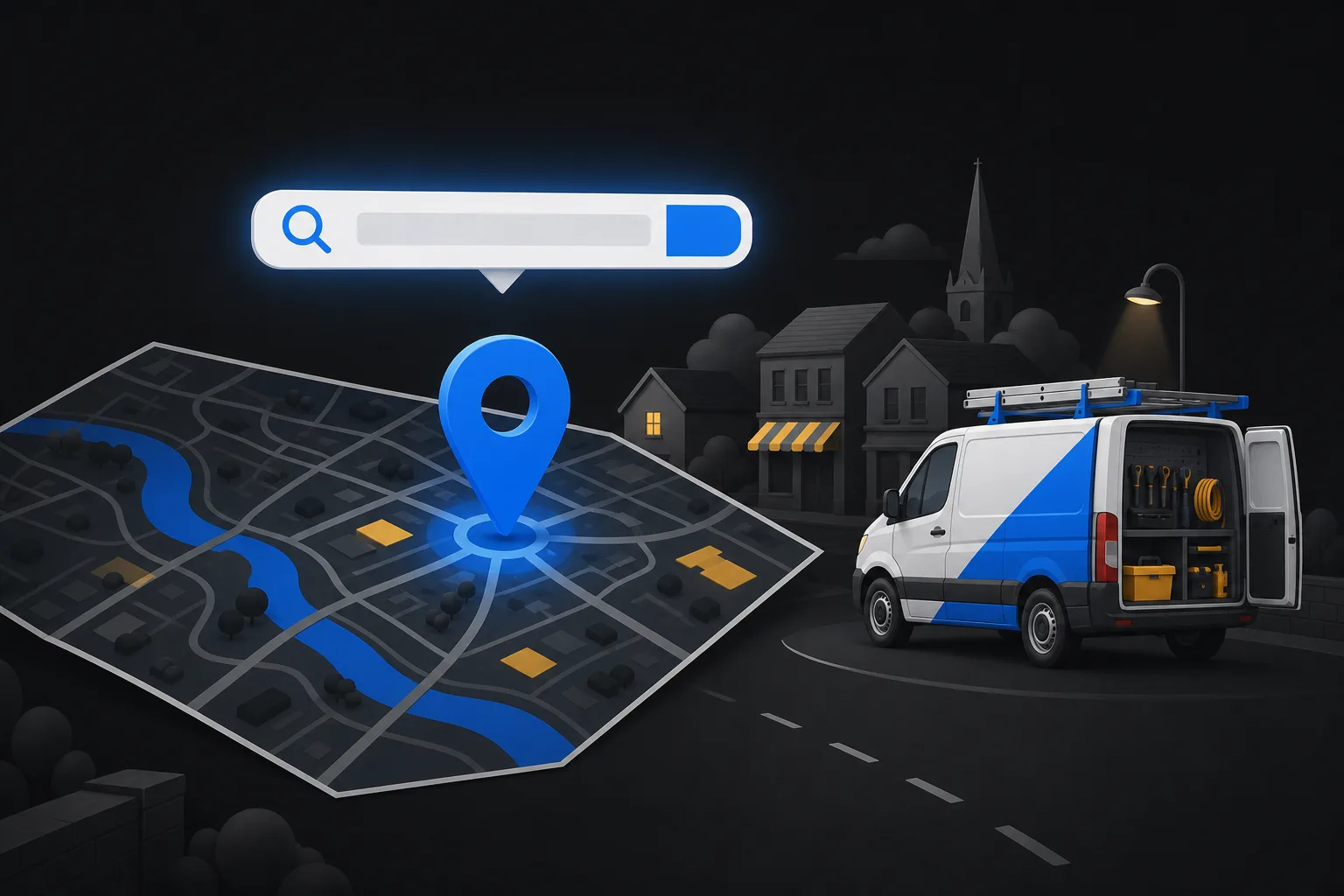
Local SEO has a reputation for being complicated. It is not. It is a fairly short list of jobs, done properly and then kept up. The complication comes from agencies who benefit from you not understanding it.
If you run a trade or a local service business in the UK, this is what genuinely affects whether you appear when someone nearby searches for what you do.
What "local search" actually means
Type "electrician near me" into Google on a phone and you generally get three things stacked on the screen:
- Paid adverts at the top.
- A map with a short list of local businesses, often called the local pack.
- Ordinary blue links below that.
Local SEO is the work of getting into the map results and the blue links underneath. They are driven by overlapping but different factors, which is why some businesses appear on the map and not in the links, or the other way round.
Google is broadly trying to answer three questions: how relevant is this business to the search, how close is it to the searcher, and how prominent is it. You cannot change your location easily. You can absolutely change relevance and prominence.
Step one: your Google Business Profile
This is the free listing that powers the map results, and it is the single highest-value thing most local businesses can fix in an afternoon.
At minimum, make sure you have:
- Claimed and verified the listing.
- Chosen the most accurate primary category, then added secondary ones.
- Written a description that says what you do and where.
- Listed your services individually.
- Added real photographs of your work, your van, your premises and your team.
- Set correct opening hours, including bank holidays.
- Added a link to your website, and where possible to the relevant service page rather than always the homepage.
Then keep it alive. Post occasionally, add new photos, answer questions, and reply to every review. A profile that is updated regularly tends to do better than one that was filled in once and abandoned. We cover this in more depth in our separate guide to Google Business Profile optimisation.
Step two: get your name, address and phone number consistent
Google cross-references your business details across the web. If you are "Smith & Sons Plumbing" on your website, "Smith and Sons Plumbing Ltd" on Facebook, and listed at two different phone numbers on old directory entries, that inconsistency works against you.
Pick one exact format for your business name, address and phone number. Use it everywhere. Then work through the places your details already appear: your website footer, Google, Bing Places, Facebook, Yell, Checkatrade, Trustpilot, trade association listings, your local chamber of commerce. Fix the ones that are wrong.
This is dull work. It also has a genuinely measurable effect, which is why it is one of the first things we do on any local SEO engagement.
Step three: build proper pages for your services and areas
Google cannot rank a page you have not written. If you want to appear for "boiler repair Nottingham", there needs to be a page about boiler repair in Nottingham.
That does not mean churning out fifty near-identical pages with the town name swapped, which Google has been able to spot for years and which reads badly to customers anyway. It means:
- One solid page per significant service, with a clear heading, an honest description of what the job involves, real photos and an enquiry form.
- Pages for the two or three areas that actually matter to your business, with genuine local content: projects you have done there, areas you cover, travel times, local considerations.
- Your main location named naturally in page titles, headings and body text.
Our packages scale by page count for this reason: Growth at £799 + VAT includes keyword and page planning so the structure is right from the start, and larger builds add service-specific and location pages.
Step four: reviews
Reviews influence both your ranking and whether anyone actually calls you. A business with 40 recent reviews and a 4.7 average will out-convert one with six reviews from three years ago, even if it appears slightly lower on the page.
Practical approach:
- Ask every satisfied customer, at the moment the job finishes and they are happiest.
- Make it one tap. Google gives you a short review link you can text.
- Never buy reviews or write them yourself. It is against Google's rules, it is obvious to readers, and it can get your listing suspended.
- Reply to all of them, good and bad. A calm, factual reply to a negative review often impresses future customers more than the positive ones do.
Step five: the technical basics on your website
None of the above rescues a website that is slow, broken on mobile or invisible to search engines. The essentials are:
- Mobile-first design. Most local searches happen on a phone.
- Fast loading. Compressed images, sensible hosting, minimal scripts.
- A unique page title and description for every page, containing the service and the location.
- Proper heading structure, one main heading per page.
- Local business structured data so Google can read your address, hours and contact details reliably.
- An HTTPS certificate on every page.
- A sitemap submitted in Google Search Console.
Search Console is free and worth setting up even if you do nothing else. It tells you which searches you already appear for, which is usually more interesting than business owners expect.
How long does local SEO take?
This is where honesty matters, because the industry is not always honest about it.
Google Business Profile improvements can show up within a few weeks. Website changes such as new service pages, better titles and improved speed typically take one to three months to settle into the results. Competitive terms in a city centre can take considerably longer, and some will never be realistic against firms who have been at it for a decade with far bigger budgets.
Anyone promising you first place on Google within 30 days is either misunderstanding the work or misleading you. What a good SEO programme should promise is steady, measurable improvement and a clear report of what was done.
What to do first if you only have a few hours
If you have limited time, this is the order that gives you the most for the least effort:
- Claim and fully complete your Google Business Profile.
- Get five recent genuine reviews.
- Make sure your website loads quickly on a phone.
- Write a proper page for your most profitable service.
- Fix your business details wherever they are wrong online.
That list alone puts a lot of small businesses ahead of their local competition.
When it is worth paying for help
Ongoing SEO makes sense when you have competition worth beating and margin worth defending. Our SEO Boost plan is £299 + VAT a month and covers two content pieces a month, on-page optimisation, keyword targeting, Google Business Profile work, technical checks, Search Console monitoring and a monthly performance report. You can see examples of results work in our SEO projects.
If you are not sure whether you need it yet, that is a fair position. Book a free discovery call and we will tell you honestly where your local visibility stands and whether paid help is worth it for your business.