SEO vs Paid Ads for Small Businesses: Where to Spend First
Ads buy attention now. SEO earns it over time. Here is how to decide which one your business should fund first, and when to run both.
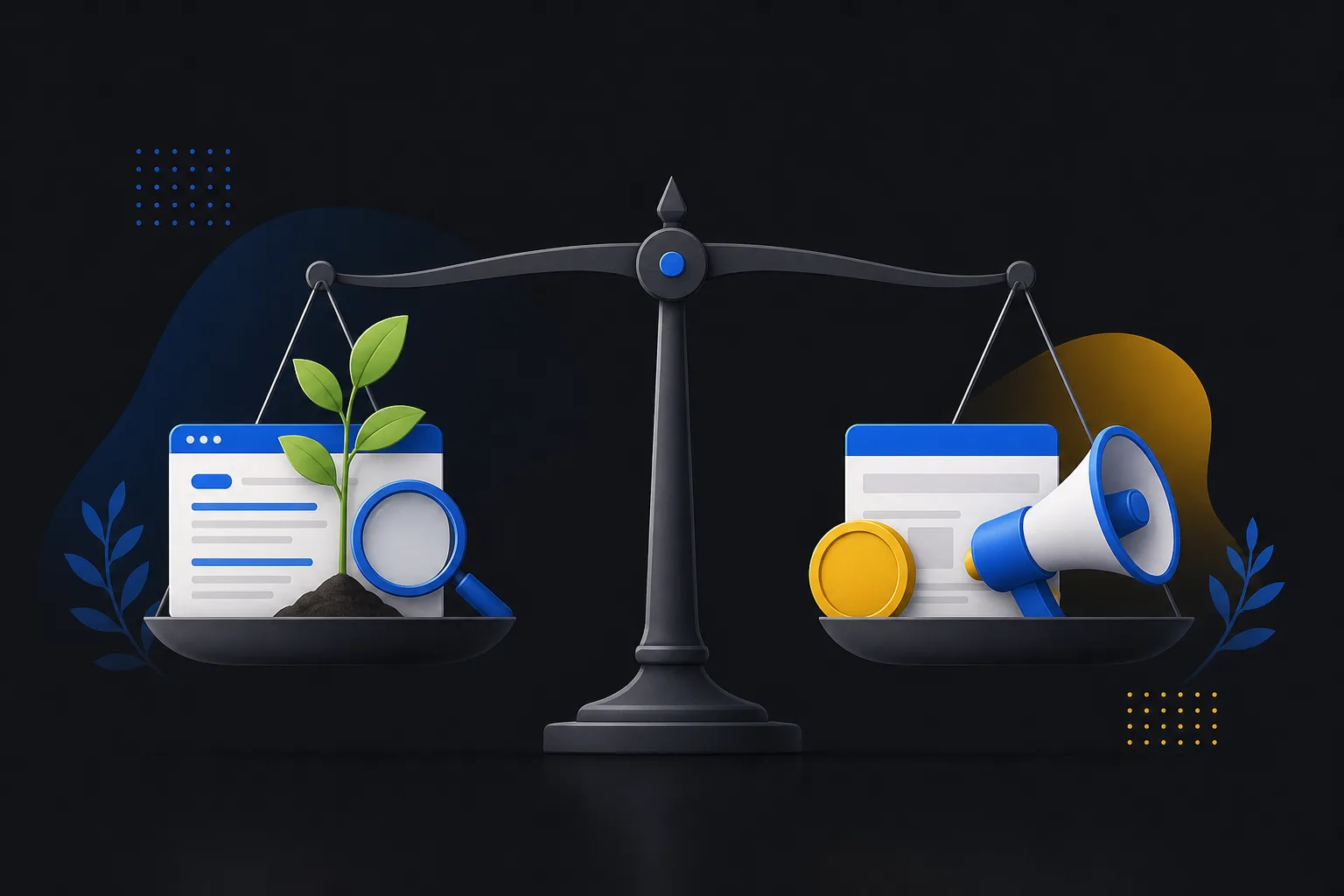
Every small business with a marketing budget eventually faces this decision. Do you pay Google to put you at the top today, or invest in earning that position over the coming months?
Both work. They work differently, they cost differently, and the right answer depends on your margins, your timescale and your patience. Here is how to think it through without the sales pitch from either side.
The basic difference
Paid ads put you at the top of search results immediately. You pay per click. Stop paying and you vanish the same day.
SEO improves your position in the ordinary results underneath. It takes months to build. Once established, the traffic keeps arriving whether or not you spend anything this month.
Ads are rent. SEO is a mortgage. Neither is inherently better, but they suit different situations.
The case for paid ads first
You need work this week
This is the strongest argument by a distance. If your diary is empty in a fortnight, SEO is the wrong tool. Ads can be running within hours and producing calls the same day.
You are testing something
New service, new area, new business entirely. Ads tell you within a week or two whether anyone actually searches for the thing you want to sell and what they are worth. That is genuinely useful market research, and it stops you spending six months on SEO for a service nobody wants.
Your work is high value or urgent
Emergency call-outs, commercial contracts, anything with a decent margin per job. If one job is worth £2,000 to you, spending £200 on clicks to win it is straightforward maths.
The market is seasonal
Gutter clearing in autumn, air conditioning in a heatwave, log burners in October. Ads let you turn spending up and down with demand, which SEO cannot do.
The honest downsides
Costs per click in competitive trades can be uncomfortable, and in some sectors a single click costs more than a small business expects to spend in a day. Badly set up accounts burn money on irrelevant searches with alarming speed. And the moment you stop paying, it all stops.
The case for SEO first
The traffic compounds
Money spent on SEO builds an asset. A service page that ranks well keeps bringing enquiries for years at no additional cost per enquiry. It is the difference between renting your visibility and owning it.
It is cheaper per enquiry over time
In the first few months, SEO usually looks worse than ads on a cost-per-enquiry basis. Over a year or two it often looks considerably better, because the cost stays flat while the traffic grows.
People trust the ordinary results
Plenty of searchers scroll past adverts, some deliberately. Appearing in the organic results and the map pack carries a credibility that a sponsored label does not.
It improves everything else
Good SEO work means faster pages, clearer structure, better content and a properly optimised Google Business Profile. All of that also makes your ads perform better and your website convert more of the visitors it already gets.
The honest downsides
It is slow. Meaningful movement typically takes three to six months, sometimes longer in competitive city markets. You cannot switch it on for a quiet fortnight. And it requires consistency: a couple of months of effort followed by nothing tends to fade.
A simple way to decide
Answer these honestly.
How soon do you need enquiries? Within a month means ads. Within six months means SEO.
What is a customer worth? High value jobs justify paid clicks. Low value, high volume work usually needs the cheaper long-term route.
How much can you commit monthly, reliably? SEO needs consistent months to work. Ads need a budget you can top up. A small budget spread thinly across both usually achieves neither.
Is your website actually ready? This one is decisive and often ignored. Sending paid traffic to a slow site with no clear enquiry route is pouring money away. Fix the site first, whichever channel you choose afterwards.
Are you competing locally or nationally? Local SEO for a specific town is achievable for a small business. National organic rankings for a broad commercial term are a different sport entirely.
What we usually suggest
For most local service businesses in the UK, a reasonable sequence looks like this.
First: fix the website. No marketing channel outperforms a broken destination. Fast, mobile-first, clear services, obvious contact routes. Our web design packages start at £499 + VAT and include SEO-ready foundations, so the groundwork for the next steps is already in place.
Second: do the free local SEO work. Claim and complete your Google Business Profile, gather reviews, get your business details consistent. This costs nothing but time and is often the highest return activity available to a small local business.
Third: run modest ads if you need work now. A controlled budget on your most profitable service, in your actual service area, with tight negative keywords so you are not paying for irrelevant clicks.
Fourth: commit to ongoing SEO once cash flow allows. This is the part that reduces your dependence on paid clicks over time. Our SEO Boost plan is £299 + VAT a month and includes two content pieces a month, on-page optimisation, keyword targeting, local SEO and Google Business Profile work, technical checks, Search Console monitoring and a monthly report. Everything is listed on our pricing page.
Running both together
If the budget allows, the two support each other rather than competing.
Ads give you data. The search terms that convert in your ad account are exactly the terms worth targeting organically, which removes a lot of the guesswork from SEO.
SEO reduces your ad dependence. As organic positions improve, you can pull back paid spend on the terms you now rank for and redeploy it elsewhere.
Together they take up more of the page. Appearing in the ads, the map results and the organic listings for the same search is a strong position to be in.
What to avoid
- Long ad contracts with agencies who will not show you the account. You should own your Google Ads account and be able to see exactly what is being spent.
- SEO packages with guaranteed rankings. Nobody can guarantee a position. Anyone who does is either misinformed or misleading you.
- Spending on either while your website cannot convert. Traffic to a bad site is an expensive way to prove the site is bad.
- Stopping SEO after two months. It is the equivalent of cancelling a gym membership in week three and concluding exercise does not work.
The short version
Ads buy attention now and stop when you do. SEO earns attention slowly and keeps it. Most small businesses should get the website right, do the free local SEO groundwork, use ads to bridge the gap while organic visibility builds, then invest steadily in SEO so they are not renting every enquiry forever.
Book a free discovery call and we will give you a straight recommendation on where your budget goes first, even if the answer is not one of our services.